Accessibility · Innovation · Payments
Accessible payments: when personal experience transforms innovation
From his friendship with Pierre Achache to temporary sight loss, Nicolas Riegert explains how lived experience changed his approach to accessibility and payment innovation.
01
I remember one taxi payment very clearly
I could still see, but poorly. The terminal was in front of me and its screen was lit, yet I could not read the amount despite every effort.
I brought it closer and strained my eyes until the white light made them water. A question that had once belonged to product thinking became painfully concrete: with all the technology available, how can we still design a payment method that some people cannot use independently?
That question would deeply influence part of our work at PayXpert. The story, however, had begun much earlier.
“How can we design a payment method that some people cannot use independently?”
02
Pierre
Pierre Achache was my founding partner in the venture that became PayXpert. When we met, he supplied French telecom lines to the company I ran in London. After his business was acquired by SFR, our professional paths separated for a time, but we had become close friends.
Pierre is blind. He lost his sight as a young adult and had to leave university teaching, but not professional life. He built Minitel services, moved into value-added telecoms, became my supplier and, years later, my partner.
03
We literally walked side by side
When we travelled, Pierre would place a hand on my shoulder or take my arm. We moved side by side in every sense.
What fascinated me was not what he could not see, but everything he rebuilt differently: an extraordinary memory for figures and people, sharp product intuition and an immediate grasp of new surroundings.
In a hotel I would point out the bed, bathroom, doors and obstacles. Minutes later, he moved independently. People who did not know him did not always realise he was blind.
“Helping someone is not the same as making them dependent.”
04
Cuba: when one personal story triggers another
Pierre identified a Cuban medical programme related to his condition. As he did not speak Spanish, I travelled with him to understand what it genuinely offered.
We were told the centre originated in a young doctor’s response to the suicide of a close friend facing progressive sight loss. The programme did not promise to restore vision, but aimed to preserve what remained.
It was not the miracle Pierre hoped for, but it strengthened my belief that many innovations begin with a deeply personal story: illness, loss, frustration or the determination to solve an intimately understood problem.
05
When I began losing my own sight
During the Covid period, stress, fatigue, weight gain and poor diet damaged my health. Within about a year, serious eye problems affected both eyes.
When the second eye was affected, total sight loss became real enough to prepare for. As CEO of the PayXpert group, my first question was practical: how could I keep working if I could no longer see my screen?
I configured my computer and phone, moved to an iPhone for its accessibility features and relied more on speech. Working daily in French, English and Spanish revealed how difficult multilingual text-to-speech and dictation could be.
After months of treatment my sight gradually returned. My view of certain products did not.
06
Then came that taxi payment
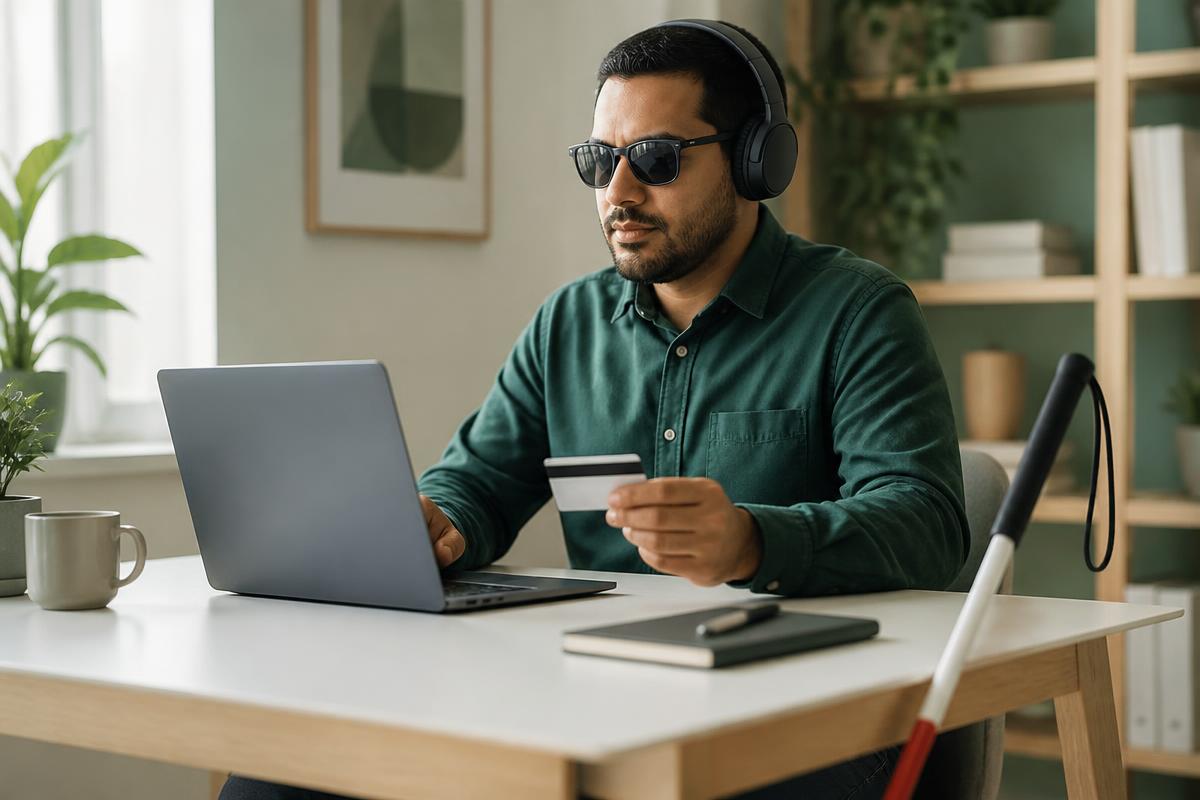
I could still make out some things, yet I could not independently verify the amount I was accepting. A blind person must trust the merchant, driver or companion for something as basic as payment.
This goes beyond user experience: can we truly speak of autonomy when someone must ask another person to check the amount before paying?
“What return on investment can we place against someone’s autonomy?”
07
Modern terminals reproducing the past
PayXpert was moving from online-only payments into physical payments. Android terminals had touchscreens, speakers, computing power, constant connectivity and a true operating system, almost everything found in a smartphone.
Yet the industry often recreated the plastic keypad of old terminals on screen. With Régis, my PayXpert partner, we began imagining a terminal designed from real user needs rather than inherited conventions.
08
What if the terminal could speak?
It could announce the amount and guide each action: present the card, enter the PIN, remove the card and confirm the operation. Multilingual guidance could help a blind person and a traveller unfamiliar with the local language.
We considered contrast, type and button size, information hierarchy, sound, touch and translation. A convenience for most can determine whether someone else can use the product at all.
Designing for people facing the strongest constraints often improves everyone’s experience.
“Designing for the strongest constraints often improves everyone’s experience.”
09
Then business reality returns
Roadmaps and development resources are finite. Certification takes time. PayXpert had to balance innovation, client requests, regulation, maintenance and economics. Some ideas advanced, some moved slowly and others stayed on the shelf.
Revenue and margin are legitimate questions: without a viable model, no company can keep funding innovation. But not every improvement can be judged by immediate profitability.
Years later, as accessibility became a clearer market obligation, ideas once considered secondary suddenly became priorities.
10
When regulation catches up with innovation
I do not oppose regulation and innovation. Regulation is often essential when economics alone cannot move an entire market. But companies should not need to wait for an obligation to understand a problem.
Without lived experience of visual, hearing, motor or cognitive impairment in a product team, barriers remain invisible. Teams optimise conversion, speed and clicks while overlooking people whose challenge is not saving two seconds, but completing the journey at all.
That is why diversity of lived experience matters in product design.
11
Magicavision: technology that restores autonomy
Pierre explored this philosophy through Magicavision, a digital toolkit using a phone and its sensors to recognise coins, notes and colours, read object or medicine information and help identify obstacles.
We presented it together at CES in Las Vegas. Its principle still guides me: do not create technology to display what technology can do. Create it so someone can do something they could not do before.
“Technology must serve people, not the other way around.”
12
Accessibility is not a feature
For too long, accessibility was treated as an optional addition after design, product and core features. That is the wrong perspective. Accessibility is first a way of designing.
It asks who may not see the information, hear the instruction, reach the button or understand the language. It also covers temporary situations: an injured arm, impaired vision, bright sunlight, noise or holding a child while paying.
Designing for difficult situations usually means designing better products.
13
What Pierre taught me before I experienced it
Looking back, Pierre taught me accessibility long before I knew it: offer a reference point rather than pulling someone, explain a space so they can become independent, ask what help is needed and never reduce a person to a disability.
Pierre is among the most independent people I know. Blindness is part of his life, not its definition. His example helped when I lost much of my own sight. Once it returned, I could no longer pretend not to know.
14
Not just another payment solution
Pierre’s story, Cuba, Magicavision, my temporary sight loss, the taxi and our discussions across the industry shaped one conviction: technology must serve people.
That does not remove economic or technical constraints. It means looking beyond the next quarter and margin line when deciding what to build.
The best innovations do not always add a feature. Sometimes they remove a barrier, restore autonomy and let someone do independently what once required help.
When personal experience reveals that barrier before others see it, we should listen. It is one of the most important things Pierre taught me, and something those months of limited sight made me understand in a way I never wanted, but will never forget.
Explore further