Art · Collecting · Legacy
Art collecting: objects, memory and family stories
From ethnic masks and antique books to artworks chosen together and inherited paintings: a personal reflection on emotion, memory and legacy.
01
It began with an emotion
I have never thought of myself as a collector in the academic sense. I did not begin with a strategy, a period, an artistic school or a desire to build a coherent set. I began with an emotion.
I bought my first painting almost by chance at an art market in Amsterdam during a business trip. I did not think I was starting a collection. I simply wanted to leave with something that had held my gaze long enough to create an emotion and a thought.
That is probably still my most natural way of approaching art.
“I did not begin with a strategy. I began with an emotion.”
02
Masks: hiding something to reveal something else
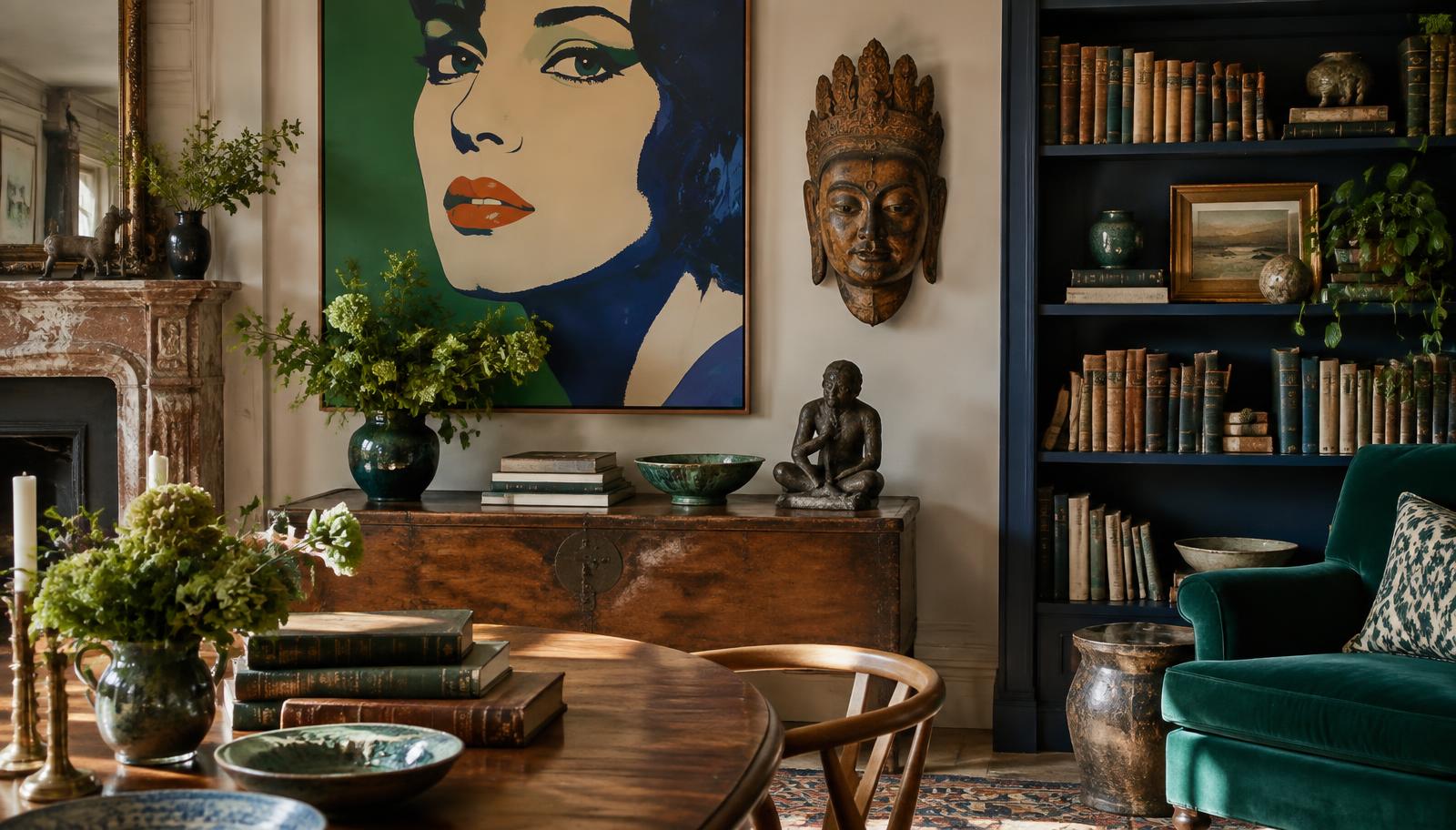
I later began collecting ethnic masks, particularly Tibetan and Chinese ones. A mask contains an extraordinary contradiction: a face is hidden behind wood to reveal a deity, a spirit, a fear, a force or another identity.
Some depict tormented or unsettling faces. They may not be beautiful conventionally, yet they exert a powerful attraction. Who wore this mask? In what ceremony? What did it represent?
That is what I love about many art objects. They do not necessarily provide an answer. They provoke a question.
“A face is hidden to reveal something else.”
03
Falling in love with an artwork together
With Isabel, art gradually took on another dimension. In New York we discovered Charles Fazzino’s work: colour, accumulation, depth and a playful way of telling a city through abundant detail.
Later in Miami we encountered Romero Britto’s very different visual language, with the same ability to trigger an immediate reaction through colour and form. These discoveries made us want more art in our daily lives. Not to fill a collection, but to live with artworks.
“Not to fill a collection, but to live with artworks.”
04
Collecting passions too
Not all our collections are paintings. Cooking is another great passion of mine. Over time I acquired historic original works connected with great chefs, alongside antique books on cooking, travel and discovery.
These worlds meet. Food tells the story of human movement, trade routes, spices and cultural exchange. A tomato, a potato, coffee or a spice can carry a story of navigation, commerce and encounters between civilisations.
I am equally fascinated by early sea expeditions, when departure truly meant heading into the unknown with incomplete charts and rudimentary instruments. Culinary and geographical discovery share the same desire: to move towards what we do not yet know.
“To move towards what we do not yet know.”
05
Paintings that cannot be replaced
After Isabel’s parents passed away, she inherited several family paintings. They are more classical than some works we chose together, but their value has nothing to do with market price. They accompanied her childhood and belong to her memories.
When we look at them, we do not see only a painting. We preserve a presence, a house, an era and people. An object may have aesthetic, historical or financial value, but above all it can acquire an emotional value that cannot be reproduced.
“We do not see only a painting. We preserve a presence.”
06
Then the walls began to fill
Isabel and I gradually acquired more work together without a rigid artistic line: some close to pop art, some figurative, some contemporary. The question remains simple: does it make us feel something, intrigue us, invite another look tomorrow or start a conversation?
Over time, paintings, sculptures, books and objects have invaded the house. Almost no wall space remains and the shelves are full. Yet it feels less like clutter than a home inhabited by stories.
“Our home is inhabited by stories.”
07
Introducing art to our children
Sharing this with our children matters deeply. We take them to museums, exhibitions and galleries, and they often join the discovery and discussion when we consider a work.
We do not want to impose our tastes, but help them develop their own: to look, say they like or dislike something, feel disturbed or amused, and above all ask why.
In a world where more cultural experience is digital, a physical work asks something different. It has scale, material and texture. Light changes it, and living beside it changes the relationship over time.
“We do not want to impose our tastes. We want them to develop their own.”
08
Living with artworks
An artwork shares your daily life. You pass it in the morning, see it in different evening light, ignore it for weeks and suddenly discover a detail you had never truly noticed.
Some works become tied to a period of life, a journey, a meeting, a home, a birth or someone no longer present. They become landmarks.
“An artwork shares your daily life and sometimes becomes a landmark.”
09
Collecting may not be the right word
Collecting can suggest accumulating, classifying or completing sets. That is not what drives us. We gather things that tell stories: a mask, a maritime expedition book, a work linked to gastronomy, an inherited painting or a piece discovered together.
The objects and eras differ, but almost all open a door onto a culture, a person, a time, an emotion, a memory or simply a question.
“We gather things that tell stories.”
10
Full walls, fortunately
We are now short of walls and bookshelves. One day we may need to choose, or find more walls. But I like our children growing up among books, paintings, sculptures and objects from very different worlds.
Digital life gives us extraordinary access to information and images. I also believe in turning the pages of an antique book, seeing time’s marks on an object and standing before a painting that is physically there.
Perhaps one day our children will look at some of these objects as Isabel looks at her parents’ paintings. They may forget the artist or price, but remember where the work hung, the conversations it prompted and the house filled with images and books in which they grew up. We have little room left, but our walls, shelves, memories and imagination are full.
“Our walls, shelves, memories and imagination are full.”
Keep reading