Sailing · Leadership · Entrepreneurship
Sailing and leadership: lessons in management and risk
From the bay of Arcachon to Buddha Boat, Nicolas Riegert explains how sailing shaped the way he decides, delegates and leads a company.
01
Freedom exercised within constraints
Sailing has been part of my life almost as long as entrepreneurship. It started as a hobby, became a passion and at times a way of living. Over the years I realised it had also deeply influenced the way I make decisions, work with others and run a company.
We like to imagine sailing as a symbol of absolute freedom: leaving when you want, choosing your destination, living at the rhythm of the sea. The reality is more interesting.
Sailing offers immense freedom, but a freedom exercised in an environment of permanent constraints: weather, wind direction, sea state, crew fatigue, mechanical problems, safety, supplies, regulation and geopolitics.
That is probably one of the reasons sailing has always attracted me so strongly.
“You choose your destination. You choose far less the conditions to get there.”
02
A passion born on the bay of Arcachon
My earliest sailing memories go back to childhood. I spent part of my holidays in Arcachon and started sailing on a family friend’s boat. At that age you obviously do not think of weather as a risk matrix or of navigation as an exercise in leadership. You simply discover the pleasure of casting off.
Then came several years of dinghy sailing, more sporting, and a motorboat licence passed while I was still a teenager. In summer I sailed on the bay of Arcachon. Gradually, the horizon widened.
Around the age of 25 I began spending several weeks at a time on yachts with friends, notably between Toulon and Corsica. A few years later I took a course at Les Glénans. When I moved to the United Kingdom, I continued training with the Royal Yachting Association, progressively passing different levels of qualification.
Sailing became more serious and the distances longer: the Canaries between Las Palmas de Gran Canaria and Tenerife, Brighton to Guernsey, Vannes to Belle-Île-en-Mer. Each passage added a little more technique and experience, but above all a better understanding of everything we do not control.
03
Finding a boat to go far
I was no longer looking for a yacht for a few weeks of holiday. I was looking for a blue-water cruiser: a solid boat, able to sail far and face difficult conditions, yet large and comfortable enough to become a real home.
I had a fairly precise project in mind: one day sailing around the world with a wife and children and experiencing another way of living. The search was long and often fruitless. Until a trip to Barcelona.
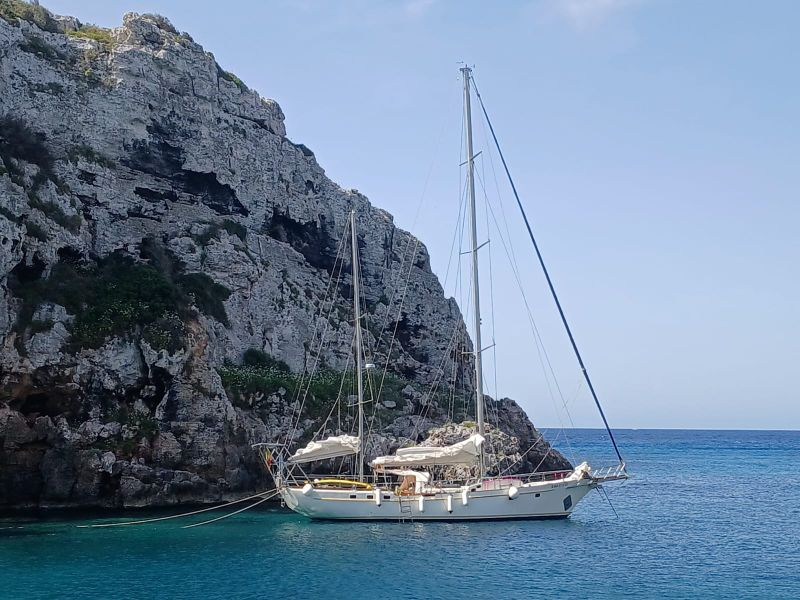
That is where I found the boat I was looking for: a large 60-foot classic yacht, built in steel, robust, with enough space to imagine a genuine life on board. She would become Buddha Boat.
For a while my life was split between London and Barcelona. Then I sold my stake in the telecom payment solutions business I had created with my partners in the United Kingdom and settled permanently in Spain. For once, it was not about building a new company. It was about sailing.
04
What if we lived differently?
Behind the purchase of Buddha Boat was a dream many sailors have probably had: sailing around the world as a family. Not necessarily to complete a circumnavigation as fast as possible, but to live differently.
For a child, such a life can be an extraordinary practical school. Geography stops being a map on a wall when you actually sail from one country to another. Physics takes on another dimension when it explains why a boat can sail against the wind. Meteorology becomes immediately concrete when the decision to leave depends on an approaching front. Mechanics stops being theoretical when a pump, an engine or an electrical system fails far from any port.
You also learn autonomy, responsibility, organisation, how to save water and energy and, above all, how to solve problems with the resources available. It is an education that can build enormous curiosity and resilience.
But over time I also understood the other side of the dream.
05
The dream and its constraints
Living on a boat as a family is not simply taking longer holidays. Educating children is a central question. Distance learning offers remarkable flexibility and can adapt to each child’s pace, but it also places a considerable load on parents, who partly become teachers, organisers and supervisors of the learning process.
Above all there is a dimension that is easily underestimated: socialisation. Children build an important part of their personality through other children, school, sport, friendships and sometimes conflicts. A nomadic family has to find other ways of recreating that social richness.
More pragmatic subjects also matter. Weather or breakdowns can immobilise a boat for days, weeks or months. Some regions become dangerous depending on the season. Geopolitical realities change. The safety of boat and crew must remain the priority. Mechanical failures do not ask whether it is a convenient moment. And living far from friends and family eventually carries an emotional cost.
The great voyage around the world did not finally take the shape I had imagined. But the boat changed my life profoundly in another way.
06
The boat that led me to meet my wife
Buddha Boat brought me to live in Spain. Sailing forced me to learn Spanish from almost nothing. I sailed and skippered the boat around the Costa Brava, the Balearics and Corsica. I also ran a few charters and taught sailing.
And it is also through sailing that I met Isabel, who would become my wife. She had grown up with sailing herself, first as a student and then as an instructor during her teenage summers. We had that language in common.
A fully nomadic family life on a boat did not match the reality we wanted to build together. Buddha Boat nevertheless remained part of our story. After many years and a very substantial refit, the boat was entirely renovated, keeping her classic character while adding the comfort and modern equipment that current cruising requires. She finally returned to Mediterranean sailing in the summer of 2026.
Looking back, I do not regret that the original dream evolved.
“Dreams may be made to give direction rather than to be executed exactly as imagined.”
07
Having a destination without falling in love with the plan
When you leave a port for a destination, the objective is clear. The plan never entirely is. You can prepare a perfectly rational route a few hours earlier and have to change it because the wind shifts, change it again because the weather deteriorates, slow down because a crew member is exhausted, then divert into another port because a mechanical problem needs solving.
The destination can remain the same while the route changes several times. That distinction between the objective and the plan to reach it seems essential to me in management.
In a company we make exactly the same mistake when we confuse strategy with planning. We define an objective, we build a plan, and a few months later, when the market, a competitor, technology, regulation or the organisation itself has changed, we sometimes keep defending the plan simply because we wrote it.
At sea that attitude can become dangerous. A skipper who refuses to change course because it was decided before departure is not disciplined. He is reckless.
“Agility is not the absence of a plan: it is a plan clear enough to know when to change it.”
08
Managing risk before taking it
Sailing also teaches you to look at risk differently. You cannot remove risk. You can identify it, anticipate it and prepare responses.
Before a passage you study the weather, check the state of the boat, anticipate dangerous areas, test essential systems, know where the safety equipment is stored and think through what you will do if something stops working. None of that guarantees nothing will happen. It simply means being better prepared when something does.
In business I have always preferred that approach to artificially chasing zero risk. Entrepreneurship implies taking risk. The question is which risks we accept, which ones we can reduce and which ones we should simply not take.
09
Deciding with imperfect information
A skipper almost never has all the information he would like. The weather is a forecast. The sea state can differ from the bulletin. Equipment behaviour is never fully predictable. Human fatigue is hard to measure.
And yet a decision has to be made: leave or stay in port, reef or wait, continue or change destination, fix a problem immediately or monitor how it evolves.
In management we sometimes look for an amount of information that would let us decide with certainty. That information generally does not exist. We have to distinguish a decision that is insufficiently prepared from a decision that simply has to be taken under uncertainty. The first is improvisation. The second is part of a leader’s role.
10
Communicating before the manoeuvre
Another essential lesson from sailing concerns communication. When an important manoeuvre is coming, the skipper should not simply give orders at the last second. He explains what is going to happen: which manoeuvre, why, who does what, at which moment, what to watch for and what we will do if something does not go as planned.
Good communication considerably reduces stress. It also allows everyone to anticipate rather than merely react.
In a company the mechanism is exactly the same. Teams accept a demanding situation far more easily when they understand where we are going, why we are going there and what role they play along the way. Communication is therefore not only about informing: it coordinates action.
11
Delegating for real
On a long passage nobody can do everything. The skipper has to sleep. Someone has to take the watch. During that period, that person becomes responsible for the vessel, its course, its environment and the safety of the crew.
That means genuine delegation. You cannot hand over the watch and then stand behind the person checking every decision. You have to train, explain the rules, define the situations in which you want to be woken, and then trust.
In a company too, delegating is not only distributing tasks. It means transferring responsibility with enough context, authority and trust for the other person to truly own it.
12
The authority of the captain
A boat is a reminder of something we sometimes hesitate to mention when talking about management: authority. A good skipper must listen to the crew, encourage discussion and be able to acknowledge a mistake. Yet some situations still require one person to decide, and the safety of boat and crew sometimes demands a clear, immediate decision.
That authority should not come from status or ego. It comes from responsibility. The captain is accountable for the safety of the boat, for the organisation of the crew and ultimately for the ability to reach the destination.
I find much of that in the role of a company leader. Participative management does not mean the absence of decision.
“Listening broadly and deciding clearly are not contradictory: they are complementary.”
13
Freedom within constraints
That is finally what sailing has taught me most: being free does not mean being able to do anything. A boat is probably one of the places where this reality is most visible. You can choose your destination, but you have to deal with the wind. You can choose to leave, but not ignore the weather. You can decide your route, but not remove the reefs. You can want to go fast, but you are responsible for your crew.
Freedom therefore exists inside a system of constraints. And the better you understand those constraints, the more intelligently you can use the space of freedom that remains.
It is an idea that goes far beyond navigation and looks a great deal like entrepreneurship. An entrepreneur controls neither markets, nor competitors, nor regulators, nor crises, nor the technologies that can transform an industry. He can, however, observe, anticipate, decide, change course, communicate with his team, prepare his organisation and keep moving towards his destination.
That is perhaps why, several decades after my first outings on the bay of Arcachon, sailing continues to fascinate me. It gives an extraordinary sense of freedom while constantly reminding us that we control only a small part of our environment. The rest is a matter of preparation, adaptation, trust and decisions. And sometimes, of knowing how to change course without losing sight of the destination.
Explore further